0
graph nodes, solved as one object
One graph · solved simultaneously
Your asset is a stack of models — reservoir, network, thermodynamics, equipment, metering, allocation, commercial terms — that were never designed to talk to each other. Today they're wired together: numbers passed one at a time, through connectors somebody built by hand. GraphSolve puts them in one object and solves them at once, with the uncertainty travelling across the joins.
Explore the graph — every node opens a domain
Measured on a full-field production model — 6,500 wells, 14,000 km of pipeline and 450+ manifolds — solved on cloud infrastructure. Not a benchmark network: a field.
The distinction that carries the weight
"Integration" is used for all of them. Only the third one can tell you the state of your system — and it's the one almost nobody sells.
Data platforms and knowledge graphs name your assets and record what is connected to what. Genuinely useful, and a prerequisite for a lot of good work — but it is a catalogue, not a calculation.
The standards for plugging one simulator into another standardise the plug, not the solve. Stability, accuracy and convergence are pushed onto whoever wires it up — and there is no uncertainty anywhere in the interface.
One system of equations across the whole asset, solved together, with a distribution crossing each join instead of a single number. This is the one we do.
Coupled vs solved
Coupling passes a single number from one separately-solved model to the next, on a timestep. The error that introduces generally cannot be computed — the field's own literature says so — and anything that isn't physics never enters the model at all.
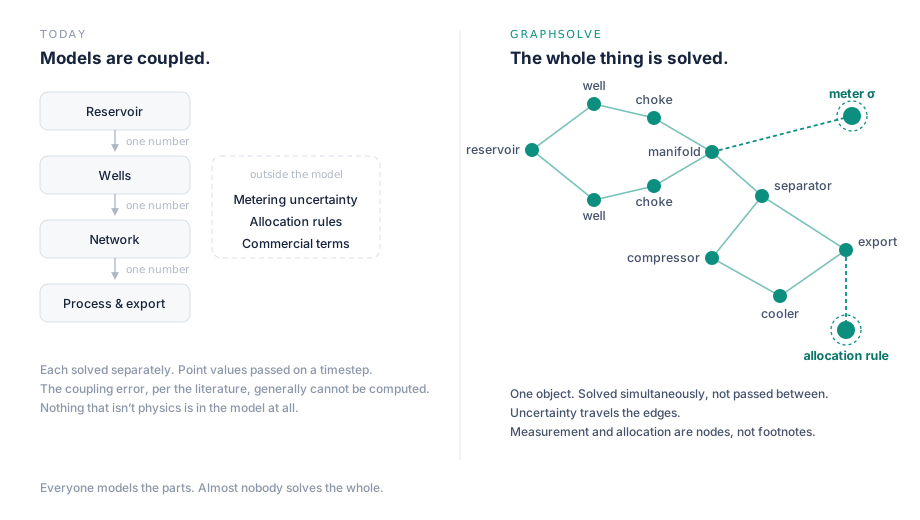
Same asset. Left: four solves and three handovers. Right: one solve.
What makes it one object
Any one of them on its own is a feature. Together they're a different kind of model — and they're what we mean when we say the graph is the thing the solver solves.
One system, solved at once — not point values handed between separately-solved models on a timestep. That handover is where an error you cannot measure gets introduced, and it compounds quietly.
The nodes aren't all the same kind of physics, and some of them aren't physics at all. A reservoir, a compressor curve, a meter's uncertainty budget and a contract term sit in the same object.
A measurement is a quantity with a distribution, and that distribution travels with it through the solve. Every number that comes out the other end knows where its error came from — and which instrument to go and check.
A metering uncertainty budget, an allocation rule and an ownership term are nodes in the graph — not footnotes in a spreadsheet downstream of it. This is the part that's hardest to bolt on afterwards.
The difference
Most integration is a translation layer.
Ours is a solve.
A graph of documents and tags can tell you what things are called. It can't tell you the state of the system. We build the graph the solver actually solves — and we solve it whole.
Where it's pointed
The method doesn't change between a reservoir and a transmission grid — the vocabulary does. That's why one company can hold both, and why what we prove in one is evidence in the other.
Oil & gas production. The physics between the meter and the money: reservoir to export in one solve, with measurement uncertainty carried through to the allocated barrel.
Grids and networks. The true state of your grid with a calibrated confidence on every value — and the sensors that have quietly drifted, flagged before they mislead anyone.
Movement and scheduling. Routes, stocks, terminals and the commercial rules stacked on top of them — in the same graph as the physics that fills them.
More domains are in reach for the same engine. We'd rather name them when they're real.
Our view on AI
Give AI better tools —
don't dress its guesses up as physics.
AI is a superb interface. It makes powerful systems approachable and puts an expert beside every engineer — and we lean into that: ask our assistant about your asset in plain language.
But an interface is not a source of truth. Where rigour — and sometimes safety — is on the line, the right way to bring AI into the room is to give it real, physics-grounded tools to reach for, not to wrap a model's output in more machine learning and call it physics. A network trained to emulate your system is still a guess, and a confident guess is the dangerous kind. Our assistant reaches for a solver running on your actual system, and reports what it truly says, uncertainty and all. The AI is the copilot; the physics is the source of truth.
Who's behind it
GraphSolve is built on the Data Insights AI engine — already in production on some of the most complex physical systems in industry.
Founder. A renowned physicist, mathematician and graph-theory pioneer — computer scientist and lecturer, and author of Lagrangian & Hamiltonian Dynamics (Oxford University Press, 2018). The research mind behind the engine.
Founder. Scientific software developer, numerical-modelling specialist and optimisation expert — the engineering depth that turns the research into a product engineers can run.
Trusted on industrial systems in the North Sea · GCC · LATAM
Get started
Tell us what your model estate looks like. We'll show you what it looks like as a single graph — and what falls out of solving it all at once.